When AI Adoption Becomes AI Theater
Why workplace AI adoption becomes performative, and how training, transparency, and outcome-based measures create real business value.
Many companies are asking employees to use AI. They buy new tools, run short training sessions, and track how often people use them.
On paper, this can look like progress. But there is an important question: Is AI improving the work, or are people using it only because management expects them to?
When a company shows a lot of AI activity without clear results, it can become AI theater. The tools are visible, but the business value is hard to find.

A warning in the numbers
A Visier survey of 1,000 full-time US employees found that 48% had exaggerated their AI use or skills at least some of the time. Another 45% felt pressure to use AI even when they were not confident about using it well.
The same study found that 59% did not believe, or were unsure, that their employer had a clear plan for how AI would affect people and jobs.
This does not mean employees are against AI. It suggests that some have received a target without receiving a clear map. If people are afraid to admit that they need help, an adoption dashboard may show more confidence than the company actually has.
Using AI is not the same as creating value
AI can save a great deal of time. However, saved time only becomes valuable when a company knows what to do with it.
BCG’s 2026 AI at Work study found that 42% of regular AI users among frontline employees saved at least eight hours per week. But 66% received little or no guidance about how to use that extra time. Only 36% felt they had received enough AI training.
That is the gap between adopting a tool and improving a business. A faster process is useful only if it produces better work, lowers costs, helps customers, or gives employees time for more important tasks.
Why AI theater happens
One cause is measuring activity instead of results. It is easy to count AI accounts, prompts, and training attendance. It is harder to measure whether AI reduced mistakes or improved a customer’s experience.
Another cause is adding AI to an old process without changing the process itself. AI may help a team complete a poor workflow faster, but it does not automatically make that workflow useful.
Training can also be too general. A presentation about AI is not enough for employees who need to apply it safely in finance, support, software development, or human resources.
Finally, employees may not know what AI means for their careers. Without honest communication, they may hide their concerns or pretend to understand more than they do.
What companies can do differently
Start with a problem
Do not begin with, “How can everyone use AI?” Begin with a real business problem:
- Which task takes too long?
- Where do mistakes happen?
- What information is difficult to find?
- What is causing frustration for customers or employees?
Then decide whether AI is the right tool for that problem.
Train people for their actual work
Employees need examples from their own roles. They should learn how to check AI output, protect private information, recognise inaccurate answers, and know when a person must make the final decision.
The OECD’s research on AI and skills says most workers do not need advanced AI expertise. They need practical digital skills, data understanding, critical thinking, and good judgment.
Make it safe to learn
Employees should be able to say, “I do not know how to use this yet,” or, “This tool does not help with this task.” That feedback is useful. It can prevent wasted money, poor decisions, and unsafe use of company data.
Microsoft’s 2026 Work Trend Index found that culture, manager support, and other organizational conditions had twice the reported AI impact of individual effort alone. AI adoption is therefore not only an employee responsibility. Leaders must create the right environment.
Measure outcomes, not appearances
Instead of asking only how often employees use AI, companies should ask:
- Did the work become faster without losing quality?
- Did errors increase or decrease?
- Was the customer experience better?
- How was the saved time used?
- Can employees use the tool safely without close supervision?
McKinsey’s State of AI research connects stronger results with practices such as redesigning workflows, setting clear governance, providing role-based training, and tracking meaningful performance measures.
My view
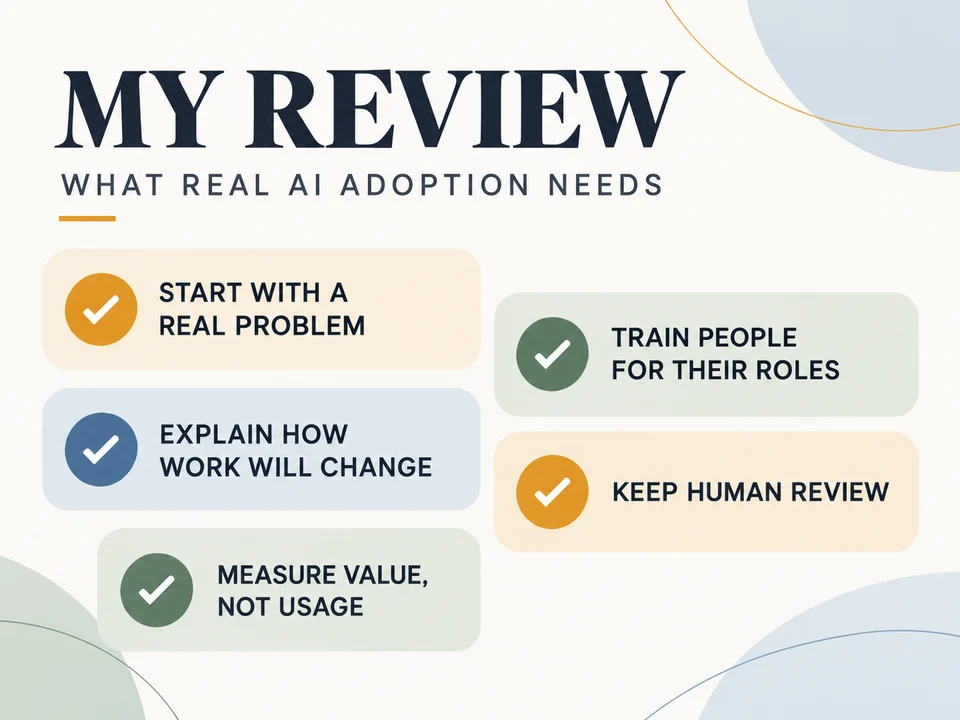
Companies should encourage AI experimentation, but they should not force people to use AI where it adds no value. A useful AI programme makes work clearer, safer, or more effective. It does not simply produce a larger usage number.
The simple takeaway: The goal is not to make employees look AI-ready. The goal is to help them become genuinely capable of using AI. When leaders provide a clear purpose, practical training, and honest communication, AI adoption can move from theater to real improvement.
Sources and further reading
Zulqurnan
Head of Engineering • Solution Architect